
Podcast Episode: Make Iran Great Again?
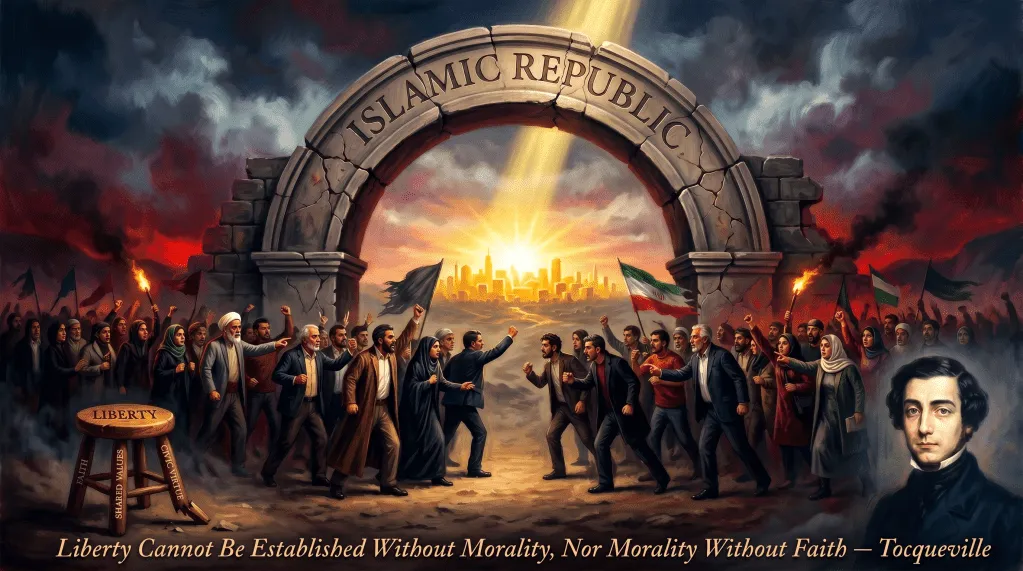
Pip: The Tocqueville Liberty Institute — where the nineteenth century’s sharpest observer of democracy gets applied to the twenty-first century’s messiest problems. Today that means Iran.
Mara: Colonel Pete’s piece takes a hard look at the Iranian protest movement, the regime’s brutal response, and the deeper question of whether rage alone can build a free society. Tocqueville’s warnings about moral foundations are doing a lot of work here. Let’s start with what the post calls the dream of a free Persia — and why it may be deferred.
Make Iran Great Again?
Pip: The question at the center of this piece is not whether Iranians want freedom — the evidence for that is overwhelming — but whether wanting freedom is sufficient to achieve it. The post argues there is a chasm between the desire for liberty and the conditions that make liberty durable.
Mara: The post sets up that chasm by reaching for Tocqueville directly. Writing in 1835, Tocqueville observed: “Liberty cannot be established without morality, nor morality without faith.” That sentence is the spine of the entire argument.
Pip: Which means the question is not just political — it is civilizational. You can topple a regime and still have nothing to put in its place if the moral and civic foundations were never there to begin with.
Mara: And the post documents just how much the regime has destroyed those foundations. HRANA confirmed over seven thousand deaths from the December 2025 through January 2026 crackdowns. Amnesty International called it the deadliest period of repression in decades. Aggregated estimates from exile networks and hospital sources run as high as thirty thousand to thirty-six thousand five hundred.
Pip: To put that in the post’s own terms, the regime may have killed more of its own citizens in weeks than the United States lost across the entirety of Vietnam.
Mara: The post then turns to the opposition itself, and this is where the French Revolution comparison enters. The Iranian opposition is fragmented across monarchists, the MEK, secular republicans, leftists, and ethnic factions including Kurds, Azeris, and Baluchis. The post notes the MEK is widely viewed inside Iran as traitors for their alliance with Saddam Hussein during the Iran-Iraq War.
Pip: Robespierre’s ghost shows up here, and not as a metaphor — as a warning. The French Revolution was also united by what it opposed, and that unity lasted exactly until the old regime fell.
Mara: The post is careful to spell out what a successful transition would actually require: a unifying transitional figure, pre-existing civic institutions, a shared constitutional vision, international support, and time. It concludes Iran currently lacks most of these.
Pip: So the cruelest legacy of forty years of theocratic rule is not just the stolen wealth or the suppressed protests — it is the systematic erosion of the civic foundations a free Persia would need to stand on.
Mara: The post closes with the same Tocqueville line it opened with, but now it reads differently — not as an abstraction but as a diagnostic. Absent a shared moral vision, the post concludes, a stable democratic Iran remains a dream deferred for at least another generation.
Pip: Which brings us back to the question the title asks — and the honest, sobering answer the post gives.
Mara: The through-line here is Tocqueville’s core insight: political freedom is a moral achievement before it is a political one. The institutions follow the creed, not the other way around.
Pip: And if that creed is still being forged in the streets of Tehran, then the next episode of this story hasn’t been written yet.